The housing crisis we keep misunderstanding.
The most powerful lever we still underutilise is land itself.
The housing story in South Africa is complex, as it affects all citizens regardless of where they reside. In telling the story, however, reassuring factors emerge, especially since 1994, when, as a nation, we have delivered more than 5 million housing opportunities that have benefited an estimated 13 million people. On the African continent, this scale of state-led intervention by our government is almost unmatched. Yet the uncomfortable truth stares back at us: after three decades, the housing backlog remains stuck between 2.5 and 3 million units and is still growing. This is not a failure of delivery but rather an indication that we are approaching the housing challenge in a manner that does not fully cater to the needs of the people.
“Yet the uncomfortable truth stares back at us: after three decades, the housing backlog remains stuck between 2.5 and 3 million units and is still growing.”
We have been solving for houses when we should have been solving for integrated human settlements. Housing is a physical structure that provides shelter, basic services and secure tenure. Human settlements are something larger. They are living systems that connect people to jobs, schools, clinics, transport and economic opportunity in a sustainable way. As a country, we have spent 30 years perfecting the first while largely ignoring the second.
The numbers substantiate this point without ambiguity. At its peak in 1999, South Africa was delivering close to 200 000 housing units annually. Today, that figure has fallen to roughly 40 000. Over the same period, the country’s population has expanded from 40.6 million in 1994 to around 64 million in 2025. We are not only faced with limited supply and a growing population alone, as rapid and often unstructured urbanisation across cities on the continent such as Johannesburg, Lagos and Nairobi has far outpaced the rate of housing delivery across the continent.
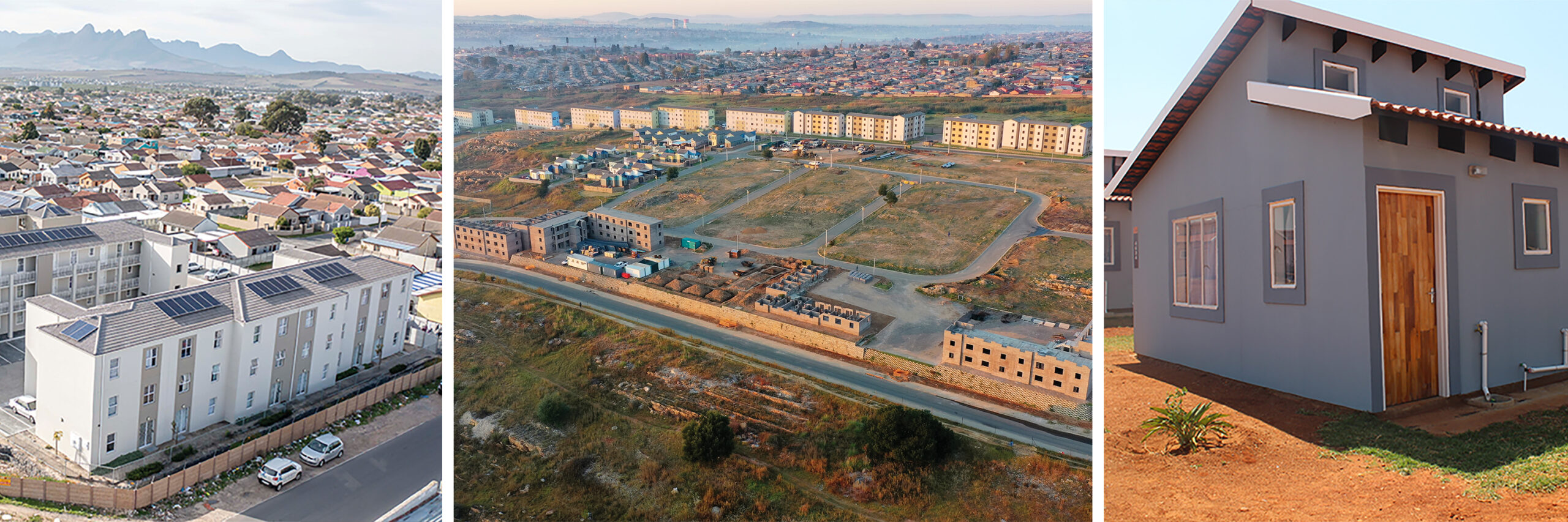
What we are witnessing is not a temporary gap between supply and demand, but the inevitable consequence of a model that is fundamentally misaligned with the realities it seeks to address. The Minister of Human Settlement, Thembi Simelane, has also agreed with these sentiments when she described the housing crisis as “a consequence of rapid urbanisation, infrastructure constraints, and escalating costs, while reiterating that the state cannot solve the challenge alone”.
Africa is dealing with many housing challenges shaped by global instability and an international financial system that limits formal housing finance to under 10% of households. Problems like consistently high interest rates, rising construction costs that outpace income growth, unpredictable urbanisation, and shortages of land caused by issues with tenure and titling add to the complexity. Macro-social factors such as inequality, poverty, and unemployment further complicate the situation. In South Africa, these problems are made worse by the spatial legacy left by apartheid. While democracy has removed discriminatory laws, the unequal distribution of geography persists. Previously disadvantaged South Africans still largely reside in townships or rural areas and have to commute to reach places of business or economic activity.
“While democracy has removed discriminatory laws, the unequal distribution of geography persists.”
South Africa now boasts one of the continent’s most advanced affordable housing financing systems, thanks to initiatives like Breaking New Ground, First Home Finance, the Integrated Residential Development Programme, and key institutions such as the National Housing Finance Corporation (NHFC) and the Development Bank of Southern Africa. While these tools are robust from a technical standpoint, they function within larger structural challenges. Fully subsidised housing supports households with monthly earnings between R0 and R3 500, while the gap market extends up to R22 000. Social housing and open market rentals serve those outside these brackets. However, no subsidy or blended finance model can truly address the issues posed by persistently low incomes or remote locations.
The outcome is the now entrenched pattern of spatial drift. As well-located land becomes increasingly unaffordable and peripheral land remains relatively cheap, development continues to push low-income households further away from centres of economic opportunity. In this context, affordability becomes a misleading concept. A house cannot be deemed affordable if it compels households to absorb high costs through transport, energy and ongoing maintenance. Affordability must therefore be understood as a function of the full cost of living over time, rather than a once-off measure at the point of acquisition.
This is why the current housing output of 42 771 units in the latest financial year feels both heroic and hopeless. To close the gap by 2033, we would need to reach 150 000 units annually while the backlog itself grows by about 180 000 units a year. Fiscal constraints, rising construction costs and declining delivery capacity make the old model unsustainable. The private sector is essential for scale, but its return expectations clash with the realities of deeply affordable, well-located development.
But the most powerful lever we still underutilise as a country is land itself. Strategic release of well-located public land, paired with bulk infrastructure, can change project economics overnight. We must also confront how we build. Traditional methods cannot deliver at the required speed or cost. Innovative technologies, passive design, natural ventilation and solar integration are no longer optional extras. These are now the only way to keep operational costs down for the poorest households and deliver genuine long-term affordability. Sustainability is not a green add-on. In African cities, it is a survival strategy.
“But the most powerful lever we still underutilise as a country is land itself. Strategic release of well-located public land, paired with bulk infrastructure, can change project economics overnight.”
John Maynard Keynes once noted that the challenge is not generating new ideas but breaking free from old ones. South Africa has plenty of policy frameworks: our Constitution guarantees the right to adequate housing, and both the National Development Plan and Breaking New Ground outline clear strategies. Nelson Mandela also once emphasised that housing is central to human rights, dignity, privacy, safety, freedom, and tackling poverty. However, what we are missing as a country is a united resolve to move beyond simply counting houses and begin focusing on how lives are truly transformed.
The shift required is not incremental but structural, moving from an understanding of housing as a standalone product to human settlements as integrated systems. This requires deliberate coordination across transport, energy, infrastructure and economic policy, with housing positioned at the centre of development strategy. Well-located and affordable housing should be recognised as a key driver of inclusive growth, not a secondary social intervention that merely responds to economic outcomes but actively shapes them.
South Africa, and the continent at large, does not need more headline numbers of units delivered. It needs integrated human settlements worthy of its people, and the time to stop escaping that truth is now.
Page created 16 April 2026
The Mercury
15 April 2026
Author: DESMOND GOLDING
Dr Golding is the Chairperson of the National Housing Finance Corporation.